Elegant Padova -- known in English as Padua -- is home to an ancient university, a Basilica that is an important centre for pilgrims and a chapel containing one of the world’s greatest art treasures. Use this website to help you plan a visit to this fascinating northern Italian city and find your way to the other beautiful towns and villages in the Veneto that are perhaps less well known to tourists.

Wednesday, April 29, 2026

Vittorio Vanzo - orchestra conductor

Versatile musician was born in Padua

Vittorio Maria Vanzo, who was passionate about the music of Wagner and introduced many of his works to Italian audiences, was born on 29 April in 1862 in Padua.

Vanzo toured both Italy and abroad as a piano accompanist and conductor and he also composed music himself.

In 1894 he conducted the orchestra of the Teatro Verdi in his home town of Padua during a run of performances of the opera, Edgar, by Giacomo Puccini.

Vanzo’s mother was from a noble family in Padua and his father was a doctor in literature and mathematics. Encouraged by his mother, Vanzo studied piano technique under the pianist and composer Melchiorre Balbi.

He then went to the Conservatory in Milan, where he studied counterpoint with Stefano Ronchetti-Monteviti and composition with Antonio Bazzini.

After graduating in 1881, Vanzo became a piano accompanist in the school for singing headed by the baritone, Felice Varesi, and he later performed in concerts throughout Italy and in other countries.

The Teatro Verdi in Padua, where Vanzo  conducted Puccini's opera, Edgar, in 1894
The Teatro Verdi in Padua, where Vanzo 
conducted Puccini's opera, Edgar, in 1894

He is perhaps best known as a conductor and interpreter of the music of the German composer, Wilhelm Richard Wagner. He had become interested in Wagner’s music while studying at the Conservatory in Milan and in order to further his studies of the works of the composer, he went to Bayreuth in northern Bavaria in 1883. There he was able to listen to the music performed in the composer’s own theatre, the Teatro del Festival. Wagner lived in Bayreuth for the last 11 years of his life.

In the same year, Vanzo directed a production of Wagner’s opera Lohengrin, which was first staged in Parma on Christmas Day.

In 1891, he married the Norwegian singer, Anna Kriebel, who he had met while he was conducting, and she was performing, at La Scala in Milan. She took part in Wagner’s Lohengrin and Tanhauser, and Vanzo also went on to be her piano accompanist when she performed in Lieder concerts.

Later that year, he conducted the first Italian performance of Wagner’s opera, La Valchiria (The Valkyrie) at the Teatro Regio in Turin, and in 1893 he revived the opera for the Teatro Comunale in Trieste.

Vanzo also conducted Puccini’s Edgar at the Teatro Giglio in Lucca and at the Teatro Regio in Turin.

During his career, Vanzo conducted operas by the Italian composers Catalani, Boito, Leoncavallo, Pergolesi, and many others.

Vanzo's wife, the Norwegian soprano, Anna Kriebel
Vanzo's wife, the Norwegian
soprano, Anna Kriebel
He met the Norwegian composer Edvard Grieg in Norway in 1897, who had heard his interpretations for orchestra and piano, and Grieg later said he had been impressed with the technical skill and virtuosity of the conductor and composer.

In 1906, Vanzo abandoned his conducting career to devote himself to composition. He composed music for voice with piano accompaniment, chamber music, a sonata for piano and mandolin, and an opera, whose score was never published. He also opened an opera singing school in Milan.

Vanzo and his wife, Anna Kriebel, had three children. Vanzo’s wife died in Milan in 1926, and the conductor and composer also died there himself in 1945.

The Teatro Verdi, where Vanzo conducted the orchestra for a run of an opera by Puccini in 1894, is a beautiful 18th century theatre named after the composer Giuseppe Verdi. It is located in Via del Livello in the centre of the city, close to Piazza dei Signori.


Home


Sunday, February 1, 2026

The tomb of Antenore

Padua’s founder was thought to be a Trojan warrior

A medieval monument believed to house the remains of Antenore, the legendary founder of Padua, stands in Piazza Antenore, close to the University and other famous sights in the centre of the city.

The monument consists of a small Romanesque shrine with a roof, which was built in the 13th century by Lovato dei Loviti, a well-respected humanist and poet, to accommodate an ancient sarcophagus he thought contained what was left of the famous warrior.

This had followed the discovery by him in Padua in 1283 of a skeleton of a warrior inside a coffin in a stone sarcophagus along with a sword and some gold coins.

Loviti believed the remains to be those of Antenore, the Trojan hero credited with founding Padua by the poet Virgil in the Aeneid. He asked for the unearthed sarcophagus to be placed in front of his own house and composed verses in Latin to be inscribed on the stone.

The monument containing Antenore's stone sarcophagus

Antenore was depicted in Greek mythology as a traitor to the Trojans, which is why he had to leave Troy. According to Virgil he fled to Northern Italy and founded the ancient city of Patavium.

Loviti arranged for his own tomb to be placed alongside the monument to Antenore before he died in 1309. However, modern studies of Antenore’s remains have raised doubts about whether they actually belonged to Antenore. It is thought that they may have been the remains of a Hungarian warrior from the ninth century.

Also, some scholars have suggested that the claim Antenore founded Padua may have just been a poetic invention by Virgil.

Piazza Antenore did not exist until 1937, when the square was created after buildings near the monument were demolished to provide a better view of it. Antenore’s tomb is now in front of Palazzo Santo Stefano, which was built in 1811.

The piazza can be found just off Via San Francesco, which is a turning off Riviera Tito Livio, a busy thoroughfare, along which the tram runs between the railway station and the Basilica di Sant’Antonio.

Home


Monday, September 15, 2025

Gaetano Cozzi – historian and writer

Academic became Padua University professor

Historian Gaetano Cozzi, who became an expert on the statesman Paolo Sarpi and taught at Padua University in the 1960s, was born on 15 September 1922 in Zero Branco in the province of Treviso in the Veneto.

Although confined to a wheelchair for most of his adult life, Cozzi became famous internationally because of his research into the life of Sarpi, and his own writing about the relationship between law and society in Italy.

Cozzi overcame disability to  become an important academic
Cozzi overcame disability to 
become an important academic
Cozzi grew up in Legnano, a municipality of Milan, and went to military school. At the age of 20, he became a second lieutenant in the Alpine troops. While attending a training school in Parma he was kicked by a horse and suffered a leg wound. A vaccine injected into him to treat the wound caused a serious infection and although his condition stabilised after a few months he was left paralysed in his lower limbs.

He had to have frequent periods in hospital, but his medical treatment, rather than demoralising him, stimulated him intellectually. He began to take an interest in politics and came into contact with the Liberal Party in Italy. He contributed to the Resistance in 1943, while lying in his hospital bed, by writing for Italian newspapers that carried propaganda pieces.

Despite being paralysed, Cozzi prepared to take his University exams and he graduated in History of Italian Law at the University of Milan in 1949. His thesis was about the writer Paolo Sarpi, and the relationship between the state and the church in Italy.

Cozzi moved to Venice to continue his research, even though life was difficult for him there because of his disability. After the founding of the Institute for the History of Venetian Society and State, he was appointed its secretary in 1955.

His first book, about Niccolรณ Contarini, who was the Doge of Venice in 1630, had to be dictated by Cozzi to his mother in 1958 because his illness had once again forced him to lie in bed.

Cozzi was appointed to teach history at the Faculty of Foreign Languages and Literature in Venice and while attending a meeting at the Giorgio Cini Foundation in 1960, he met Luisa Zille, an expert in Philology, who he married in 1962 in Venice. He later collaborated with his wife to edit the Complete Works of Paolo Sarpi.

In 1966, Cozzi was appointed by the prestigious University of Padua to teach Medieval and Modern History at their faculty of Political Sciences.

Casa Cozzi, near Zero Branco, has been converted into a cultural centre
Casa Cozzi, near Zero Branco, has been
converted into a cultural centre
Cozzi was a prolific writer about criminal justice and prisons in the Venetian republic and he also wrote The History of Venice, published in two volumes in 1986 and 1992.

In 1987, he became a board member of the newly established, Treviso based, Benetton Foundation for Studies and Research.

Cozzi’s writing and research had to be interspersed with long periods in hospital because of complications with his health. He suffered a further blow when his wife, Luisa, who was suffering from depression, took her own life in 1995.

His teaching career came to an end in 1998 with a ceremony at Ca’ Foscari in Venice, where he was awarded the title of Professor Emeritus.

The historian died in 2001 in Venice at the age of 78. He was buried in the cemetery at Zero Branco next to his wife, Luisa. His gravestone bears the inscription: ‘Still together, always together.’

Zero Branco is a municipality in the province of Treviso, located about 37 kilometres (22 miles) northeast of Padua. Casa Luisa e Gaetano Cozzi in Via Milan is now a cultural centre in the countryside outside Zero Branca, having been bequeathed to Fondazione Benetton in Gaetano Cozzi’s will. It is now an eight-hectare complex consisting of a former farmhouse, rustic outbuildings, and agricultural land, which is used by the Benetton Foundation for agricultural research.  

A library houses Cozzi’s documents and archives, which  are made available to scholars. Luisa’s Bechstein piano is preserved there and musical activities take place at Casa Cozzi in her memory.


Home

Saturday, March 15, 2025

Church of the Eremitani

Home of Andrea Mantegna’s famous frescoes

Padua's Chiesa degli Eremitani dates
back to the 13th century
Near the Giardino dell’Arena, where you can still see the remains of Padua’s Roman Ampitheatre, stands the Chiesa degli Eremitani, or Church of the Hermits, one of the most important churches in the city in the 14th century.

The Church of the Eremitani was built for Augustinian friars between 1260 and 1276 and dedicated to the Saints Philip and James. The friars remained in the church and adjoining monastery until 1806, when Padua was under Napoleonic rule and the order was suppressed. The Church was reopened for services in 1808 and became a parish church in 1817.

The church has a plain faรงade and a loggia with a circular rose window above it. Inside, it has a single nave with plain walls decorated with ochre and red bricks and a vaulted wooden ceiling.

It houses the ornate tombs of two lords of Padua, Jacopo II da Carrara and Ubertino da Carrara, which were designed by Andriolo de Santi. The Musei Civici agli Eremitani (Civic Museum) of Padua is now housed in the former Augustinian monastery to the left of the church.

In the Chapel of the Ovetari family, Andrea Mantegna began his artistic career at the age of 17. One of the heaviest losses to Italy’s cultural heritage during World War II occurred in 1944 in Padua when 15th century frescoes painted by Mantegna were blown into thousands of pieces by bombs.

The damage the church suffered in the air raid was considerable
The damage the church suffered in
the air raid was considerable
A raid on the city was carried out by the Allies, hoping to hit Padua’s railway station and a building where the occupying Germans had established their headquarters. But the bombs landed on Padua’s Church of the Eremitani instead, causing devastating damage to the beautiful frescoes created by the young Andrea Mantegna in one of the side chapels.

It was one of the worst blows inflicted on Italy’s art treasures during the war, as Mantegna’s frescoes, which had been painted directly on to the walls of the church, were considered a highly important work.

Andrea Mantegna, who was born near Vicenza in 1431, had been commissioned to paint a cycle of frescoes in the Ovetari Chapel, one of the side chapels in the Church of the Eremitani.

The commission marked the beginning of Mantegna’s artistic career when he started work at the age of 17 in 1448. The artist was in his mid-20s by the time he had finished the cycle in 1457, which showed scenes from the lives of Saint James and Saint Christopher.

Panels on the walls of the chapel show how the frescoes looked
Panels on the walls of the chapel
show how the frescoes looked
Tragically, the German invading army had established their headquarters in Padua next to the Church of the Eremitani. When the bombs fell in 1944, the chapel and the wonderful frescoes were severely damaged. They were reduced to more than 88,000 separate pieces, which were later found mixed in with bit of plaster and bricks on the ground.

Fortunately, a detailed photographic survey of the work had been made previously and it was possible later to reconstruct the artist’s designs and recompose part of the cycle depicting the Martyrdom of Saint James. 

Fragments that could be identified have been fixed to panels on the walls of the chapel where the frescoes were originally painted, which gives visitors some idea of how they looked before the church was bombed.

Other frescoes by Mantegna had been removed before the war to protect them from damp, and they remained undamaged and were eventually reinstated in the church.

In other chapels in the Church, 14th century frescoes painted by Guarentio and Giusto de’ Menabuoi miraculously survived.


Home


Monday, September 9, 2024

Matteo Strukul – bestselling writer from Padua

Author has achieved worldwide fame

Matteo Strukul, born in Padua in 1973, is best known for his novels about the Medici family
Matteo Strukul, born in Padua in 1973, is best
known for his novels about the Medici family
The novelist and journalist Matteo Strukul, whose work has now been published worldwide in many different languages, has just celebrated his 51st birthday. He was born in September 1973 in Padua and he set his first novel in his native region of the Veneto.

Strukul is best known for his four historical novels about the Medici family, which were set in Florence between the 15th and 17th centuries and followed the rise of the house of Medici. They all became best sellers in Italy and have sold more than 500,000 copies worldwide.

The first novel in the series, I Medici, una dinastia al potere, was awarded the Premio Bancarella in 2017. This prestigious award has been won in the past by Ernest Hemingway, Boris Pasternak, Umberto Eco, and Ken Follett. The novel was published in English in 2019 under the title Medici Ascendancy.

Matteo Strukul studied law at the University of Padua and went on to study for a PhD in European Contract Law at the Ca’ Foscari University of Venice.

Strukul’s debut novel was a dark thriller set in the Veneto, which was published in 2011 in Italian as La ballata di Mila. The novel was then translated into English and issued in 2014 under the title of The ballad of Mila. Strukul’s novels have now been translated into more than 20 different languages.

Strukul studied law at the University of Padua, whose main building is the Palazzo Bo (above)
Strukul studied law at the University of Padua,
whose main building is the Palazzo Bo (above)
The author is also an adjunct professor of interactive storytelling at Link Campus University in Rome and writes in the cultural section of the weekly magazine Il venerdi di Repubblica.

His latest novel, La crypta di Venezia, was published in April this year (2024).

Strukul has also written Vlad, a comic book trilogy, for the publishers Feltrinelli, based on the historic character of Vlad the Impaler. This was the man who gave Bram Stoker the inspiration for the character of Count Dracula.

Matteo Strukul is the creator and founder of the literary movement Sugarpulp and artistic director of the festival of the same name.

On the Sugarpulp website he says his favourite wine is Raboso del Piave, which is said to be an austere wine with aromas reminiscent of morello cherry, wild blackberry and plum, but also cinnamon, leather, vanilla and pepper

The writer now lives between Padua, Milan, and Berlin.


Home

Sunday, April 28, 2024

Andrea Moroni – architect

Talented designer contributed to the beauty of Padua

Padua's Basilica di Santa Giustina is one of Andrea Moroni's best known works
Padua's Basilica di Santa Giustina is one of
Andrea Moroni's best known works
Architect Andrea Moroni, who designed many stunning buildings in Padua and the Veneto region, died on 28 April 1560, 536 years ago today, in Padua.  

Moroni was the architect of some acclaimed Renaissance buildings but has tended to be overlooked by architectural historians because his career coincided with that of Andrea Palladio.

Moroni, who spent most of his working life in Padua, made a name for himself with the Benedictine Order and obtained commissions for two Benedictine churches in Padua, Santa Maria di Praglia and the more famous Santa Giustina.

His contract with Santa Giustina was renewed every ten years until his death and he settled down to live in Padua.

He was commissioned by the Venetian Government to build the Palazzo del Podestร , which is now known as Palazzo Moroni in Via VIII Febbraio, and is currently the seat of Padua city council. It is considered one of the most significant Renaissance buildings in the entire Veneto region.

Moroni was also involved in the construction of the Orto Botanico, Padua’s famous botanical gardens, where medicinal plants were grown, and he designed some of the university buildings.

The Orto Botanico, the world's first botanical gardens, was designed by Moroni
The Orto Botanico, the world's first botanical
gardens, was designed by Moroni
It is known that he supervised the construction of Palazzo del Bo, the main university building in the city, but there is some controversy over who designed the palace’s beautiful internal courtyard. Famous names such as Sansovino and Palladio have been suggested, rather than Moroni, contributing to his talent tending to be overlooked over the centuries.

The Loggia of Palazzo Capitaniato and the 16th century Palazzetto are also attributed to him.

Born into a family of stonecutters, Moroni was the cousin and contemporary of Giovan Battista Moroni, the brilliant painter. They were both born in Albino, a comune to the north east of Bergamo in Lombardy. The architect has works attributed to him in Brescia, another city in Lombardy about 50 kilometres to the south east of Bergamo. He is known to have been in the city between 1527 and 1532, where he built a choir for the monastery of Santa Giulia.

He probably also designed the building in which the nuns could attend mass in the monastery of Santa Giulia and worked on the church of San Faustino before moving to live and work in Padua.


Home


Monday, April 8, 2024

Giuseppe Tartini – composer and violinist

Talented musician was maestro di cappella at Basilica of Sant’Antonio

Giuseppe Tartini spent much of his career living in Padua
Giuseppe Tartini spent much of
his career living in Padua
The Baroque violinist and composer Giuseppe Tartini, who spent most of his career living in Padua, composed more than 100 violin concertos and many beautiful sonatas, including the Trillo del Diavolo (Devil’s Trill), which he once said had been inspired by a dream.

Tartini became principal violinist and maestro di cappella at Padua’s Basilica of Sant’Antonio in 1721 and later founded a school of violin playing and composition in the city. His greatest pupil was Gaetano Pugnani who went on to teach the violinist, Giovanni Battista Viotti.

Tartini was born in Pirano, which was in the Republic of Venice, on 8 April 1692. His birthplace was in Venetian territory in the 17th century, but it is now named Piran and is part of Slovenia.

He went to Padua to study divinity and law but also took violin lessons and became an expert at fencing. Before he reached the age of 20, he had secretly married a protรฉgรฉe of the archbishop of Padua, but this led to him being arrested on charges of abduction, so he disguised himself as a monk and fled the city, taking refuge in a monastery in Assisi, where he continued to study the violin and played in the orchestra there.

Later, he was allowed to return to his wife by the archbishop of Padua, who had heard that Tartini’s violin playing was attracting favourable attention. The musician then spent most of his life in Padua, apart from a brief period when he was invited to Prague to play at the coronation of the Emperor and direct the city’s orchestra.

The Basilica of Sant'Antonio, where Tartini was principal violinist and music director
The Basilica of Sant'Antonio, where Tartini
was principal violinist and music director
Also a music theorist, Tartini formulated the principles of musical ornamentation and harmony. He wrote a treatise on music, Trattato di musica, in 1754, as well as a dissertation on the principles of music harmony, and a treatise on ornamentation in music. He also composed music for trios and quartets and a few religious works.

His violin playing was said to be remarkable because of its combination of technical and poetic qualities, and his bowing technique became a model for later violinists. His skill was widely recognised and he was invited to go on a concert tour of Italy in 1740.

Tartini also studied acoustics and contributed to the science with his discovery of the Tartini tone, which was a third note, heard when two notes are played steadily and with intensity.

After almost 50 years in Padua, Tartini died in the city in 1770, at the age of 77.


Home


Tuesday, January 16, 2024

Erasmo of Narni

Statue of condottiero still watches over Padua


The statue captures Erasmo's fighting spirit
The statue captures
Erasmo's fighting spirit
One of the most famous condottieri of the Renaissance, Erasmo da Narni, who had a distinguished career as a military leader, died on this day in 1443 in Padua. Known as Gattamelata, which meant the honey-eyed cat, Erasmo has been immortalised by Donatello’s bronze equestrian statue of him in Piazza del Santo. 

Erasmo had ruled over Padua from 1437, having risen to the rank of General Commander of the Armies of the Republic of Venice. He continued to serve the Venetians in a military capacity until being taken ill in 1440. 

Donatello’s bronze equestrian statue of Gattamelata is to the left of the Basilica di Sant’Antonio in Padua as you approach the church from the direction of Via del Santo. The statue was completed in 1453 and is believed to be the earliest Renaissance equestrian statue that still survives. It became a precedent for many later sculptures honouring military heroes. 

The soldier and his horse are both portrayed in life size by Donatello, instead of being larger than life as with previous, classical equestrian statues. Donatello had been commissioned by the family to create a monument in memory of the great Commander of the Armies of the Venetian Republic and the statue is mounted on a pedestal that resembles a sepulchre. Gattamelata appears in the style of a Roman emperor astride his horse. His head is uncovered and the expression on his face shows his wonderful fighting spirit. 

Born in Narni in Umbria, Erasmo went from a humble household into a military life, serving in turn the rulers of the Papal States, Rome, Florence, and Venice. With his friend, Brandolino Brandolini, he worked for the Assisi lord, Cecchino Broglia, and later, serving under another condottiero, Braccio da Montone, lord of Perugia, he played his part in the conquests of Todi, Terni, Narni, Rieti, and Spoleto and helped win the battle of Viterbo against Muzio Attendolo Sforza in 1419. 

Donatello's statue standing guard over the magnificent Basilica di Sant'Antonio
Donatello's statue standing guard over the
magnificent Basilica di Sant'Antonio 
During the War of L’Aquila, Braccio’s army was defeated and the condottiero himself was killed, so Erasmo led the remaining troops into the service of Florence. Later, Pope Martin V hired Erasmo to recapture the lands he had lost in the battles against Braccio da Montone. Erasmo was also hired by the Republic of Venice to fight against Filippo Mario Visconti of Milan. 

In the conflict, he came up against another condottiero, Niccolรฒ Piccinino, who defeated him in a battle in 1434 in which Erasmo was wounded. After defending Brescia and Verona against the Visconti army successfully, Erasmo was granted the title of General Commander of the Armies of the Republic of Venice. He was made ruler of Padua in 1437. 

The following year, the Venetians lost Legnago, Soave and Verona, which led to criticism of Erasmo, but with the help of Francesco Sforza, he was able to re-enter Verona in 1439. In 1440, while mustering a flotilla on Lake Garda, Erasmo suffered a cerebral haemorrhage. He never fully recovered from this illness and was unable to lead any further military campaigns. 

Erasmo died in 1443 and was buried in the Basilica of Sant’Antonio in Padua. Donatello’s statue of Gattamelata was later placed outside the front entrance of the church as a tribute to him. Erasmo’s daughter, Polissena Romagnola, married Tiberto Brandolini, the son of his old friend and military comrade, Brandolino, and they had two sons, Sigismondo and Leonello. Sigismondo, Erasmo’s grandson, was later considered good enough to marry into an important family in Piacenza. 

Narni, where Erasmo was born, is a hill town in the region of Umbria that is close to the exact geographical centre of Italy and there is a stone in the town marking the precise spot. Erasmo’s birthplace is in Via Gattamelata, which has since been named after him, and there is now a plaque on the outside of the house. You can reach the birthplace from Via Garibaldi, or from the end of Vicolo degli Orti.

Sunday, October 8, 2023

Church of Santa Sofia in Padua

Romanesque architectural gem had ancient origins

The church of Santa Sofia is the oldest in  Padua, dating back to the early 12th century
The church of Santa Sofia is the oldest in 
Padua, dating back to the early 12th century
The oldest church in Padua is the simple but beautiful Santa Sofia in Via Altinate, a building which is thought to date back to the 11th century.

Santa Sofia is well worth visiting to see an altarpiece painted by Andrea Mantegna when he was just 17, and the font, brought in from another church, in which the two sons of Galileo were baptised.

Built on the site of a Roman temple, Santa Sofia managed to survive 14th century modifications to make it comply with Council of Trent reforms, and the disruption caused by the invasion of Italy by Napoleon’s troops.

The church was carefully restored in the 1950s and today it still retains many of its ancient architectural features and frescoes.

It is believed that the Romanesque stone and brick faรงade of Santa Sofia was built on ground that was then considered holy between about 1106 and 1127, but the church’s semi-circular apse may have been built earlier. A document has been discovered, dated 1127, that was written to urge completion of the building work in process.

Some of the artefacts found on the site date from between the second and the fourth centuries. And, Santa Sofia’s crypt has been judged, using scientific methods, to have been built within about 50 years of the crypt of St Mark’s Church in Venice. This existed before the 11th century church was built around it to house the remains of St Mark.

The church was carefully restored in the 1950s to preserve the orginal features
The church was carefully restored in the
1950s to preserve the orginal features
Andrea Mantegna’s altarpiece in Santa Sofia, depicting the Madonna and Child in conversation with saints, was painted in about 1450. It was the artist’s first independent work and when he signed it, he gave his age as 17.

Santa Sofia has at times housed Augustinian and Benedictine nuns, but the nuns were expelled from the building during the Napoleonic occupation of the city.

Not to be missed near the entrance to the church of Santa Sofia, is a basin for holy water, which was brought from the Church of Santa Caterina d’Alessandria in Padua. It is believed this basin was used as a font for the baptism of the sons of Galileo.


Home

Wednesday, February 1, 2023

Why Padua University graduate Vittorino da Feltre gave free education to poor children

Vittorino da Feltre both studied and taught at Padua University
Vittorino da Feltre both studied
and taught at Padua University
Vittorino da Feltre, a scholar who was considered to have been the greatest humanist educator of the Renaissance, owed his success partly to the education he had received at the University of Padua.

Da Feltre, who was originally named Vittore dei Ramboldini when he was born in Feltre in the republic of Venice in 1378, went to study and then taught at the University of Padua. He later chose to settle in Padua and he became a successful teacher, welcoming pupils into his own home and varying his fee according to the financial situation of the pupil’s family.

He himself had come from a good family that had become impoverished and his own early education had been a struggle. This contributed to making him a strong and decisive character and made him leave his home in Feltre when he was 18 to go to Padua.

He supported himself financially while studying grammar and Latin at the university under Gasparino da Barzizza, the greatest Latin scholar of the age, by teaching grammar to children.

After receiving his degree of doctor of arts in Latin composition and logic, he began the study of mathematics. By 1415, Da Feltre was teaching both grammar and mathematics in Padua. He took students to live in his house and closely supervised their activities.

He was promoted to Chair of Rhetoric in Padua in 1422 and became one of the most popular teachers at the university.

Palazzo Bo, part of the University of Padua, where Da Feltre taught
Palazzo Bo, part of the University of
Padua, where Da Feltre taught
In 1423, he was asked to become tutor to the children of the powerful Gonzaga family, who ruled over Mantua. He agreed to do this providing he could set up his own school away from the Gonzaga court and its political influence.

He also enrolled other children to be taught at the school along with the Gonzaga children, both noble and poor children, who were selected because of their ability. The poor children did not have to pay for their education and were taught on an equal footing with the children from wealthy families. He also educated girls and did not consider the female pupils to be inferior to the male pupils.

Latin and Greek language and literature were at the centre of the curriculum of the school. The children were also taught arithmetic, geometry and music and did games and physical exercise, following the Greek ideal of development of the body as well as of the mind. The school was close to a lake and surrounded by beautiful countryside, which also contributed to the wellbeing of the pupils.

Federico da Montefeltro was among Da Feltre's pupils
Federico da Montefeltro was
among Da Feltre's pupils
Da Feltre saw education as a pathway to living a Christian life and made his pupils feel loved and cared for in terms of their health and characters. He adapted his teaching methods to their individual abilities and needs and never used corporal punishment. Among his students were Federico da Montefeltro, who became Duke of Urbino, and Gregorio Correr, who became Patriarch of Venice.

One of the first modern educators to develop during the Renaissance, da Feltre’s teaching methods were therefore innovative and many other schools in Europe were to adopt his educational model.

During his career, Da Feltre not only educated future Italian rulers and professional men but also taught Latin and Greek scholars who came to him from the east. This paved the way for the translation of the Greek manuscripts that were to inspire the Renaissance in Europe.

After Da Feltre’s death at the age of 68 in Mantua, Iacopo da San Cassiano, a humanist and mathematician who had been one of his pupils, took over the running of the school and inherited his library. Da Feltre was laid to rest in the Chiesa di Santo Spirito in Mantua. 


Home

Sunday, January 1, 2023

Capodanno in Padua

The Palazzo della Ragione in Padua, which is known locally as "il Salone"
The Palazzo della Ragione in Padua, which is
known locally as "il Salone"
New Year’s Day is called Capodanno in Italy, which literally means ‘head of the year.’ After a late start following the New Year’s Eve festivities, many families will enjoy another traditional feast together, either at home or in a restaurant.

Both visitors to Padua and residents may attend church services before sitting down to a festive meal and toasting the new year again with a glass of good prosecco.

Piazza delle Erbe, Piazza della Frutta e Piazza dei Signori in the centre of the city are places where locals and visitors gather to enjoy un aperitivo or meal together, or to visit the market ‘under il Salone’, with its excellent food shops selling Padovan specialities.

Buon Anno e Tanti Auguri per 2023 da Best of Padua!


Home


Thursday, March 17, 2022

The statue of the playwright known as Ruzzante

Sculpture stands outside Teatro Verdi

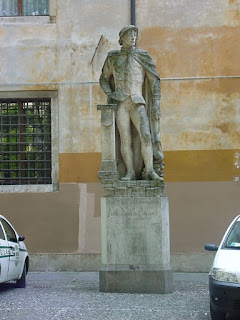
The statue of Angelo Beolco stands opposite the Teatro Verdi
The statue of Angelo Beolco stands
opposite the Teatro Verdi
(photo by DracoRoboter via Wikimedia Commons)
Visitors to Padua’s Teatro Verdi off Padua’s Corso Milano will notice on a plinth opposite the entrance in Piazzetta Terrani a statue of a man dressed in a simple tunic, cape and hat.

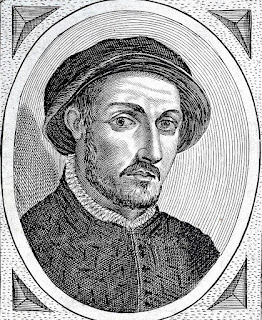
It commemorates one of the most powerful Italian dramatists of the 16th century, Angelo Beolco - also known as Ruzzante or Ruzante - who was born in Padua and died in the city on 17 March 1542.

Beolco was famous for his rustic comedies, which were written mostly in the Paduan dialect of the Venetian language.

Many of his plays featured a peasant called Ruzzante and they painted a vivid picture of life in the Paduan countryside during the 16th century.

Beolco was born in Padua in 1496 and was the illegitimate son of a doctor. His mother was possibly a maid in the household where he was brought up by his father. He received a good education and after his father’s death became manager of the family estate. In 1529, he also became manager of a farm owned by a nobleman, Alvise Cornaro, who had retired to live in the Paduan countryside. Cornaro later became Beolco’s friend and protector.

Beolco met and associated with Paduan intellectuals of the time, such as the poet Pietro Bembo and the scholar and dramatist Sperone Speroni, which led to him developing an interest in the theatre.

His first attempts at acting and writing plays may have been delivering impromptu sketches at wedding parties.

Angelo Beolco was born in Padua in 1496 and spent much of his life there
Angelo Beolco was born in Padua in
1496 and spent much of his life there
It is established that in 1520 he was already known as Ruzzante and that he played a role in a play put on at a palace in Venice. It was after this that he put together his own theatrical troupe. His first plays were staged in Ferrara between 1529 and 1532 and then later in Padua at the residence of his friend, Cornaro.

In Beolco’s first printed play, La pastoral, which was categorised as a rural comedy, Arcadian shepherds tell of their frustrated love affairs, while, in contrast,  the peasants Ruzzante and Zilio deliver rustic verses in dialect, spiced with vulgarities and obscenities, beginning with Ruzzante’s first line in the play.

Much of the play’s comical effect comes from the contrast between the two languages, which provides the opportunity for misunderstandings and plays on words.

In his later plays and monologues, Beolco shifts more to the Venetian language, while maintaining his social satire.

Beolco’s plays were sometimes considered unfit for educated audiences because of the lascivious themes and vulgar language and this occasionally led to performances being cancelled.

In one of his best-known pieces, Il parlamento de Ruzante, the character tells of his return from the Venetian war front only to find that he has lost his wife, land and honour. The speech begins with Ruzzante’s favourite expletive.

Linguistic studies have concluded that Ruzzante’s speech was not an accurate record of Paduan dialect of the day, but to some extent, a theatrical dialect created by Beolco.

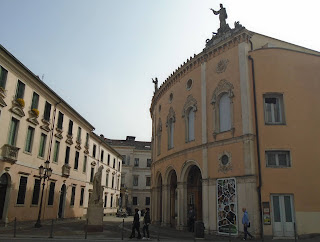
The Teatro Verdi, built in the 18th century, is named after the composer Giuseppe Verdi
The Teatro Verdi, built in the 18th century, is
named after the composer Giuseppe Verdi
Dario Fo - Italy’s celebrated 20th century playwright - put Ruzzante on the same level as the French playwright, Moliรจre, claiming that Beolco is the true father of the Venetian comic theatre (Commedia dell’Arte) and said that he was the most significant influence on his own work.

Beolco (Ruzzante) wrote at least 11 plays and monologues, but died in Padua when he was in his late forties, while preparing to stage a play by his friend, Speroni, for the Accademia degli Infiammati. Despite his theatrical success, Beolco was very poor for most of his life. Speroni once remarked that, while Beolco had an unsurpassed understanding of comedy, he was unable to perceive his own tragedy.

The statue outside the Teatro Verdi is the work of the 20th century sculptor Amleto Sartori - also from Padua - who was most famous for creating the theatrical masks used when Commedia dell’Arte enjoyed a brief revival in the mid-20th century.

To find the Teatro Verdi and see the Ruzzante statue, taking the Piazza dei Signori in the centre as the starting point, walk north along Via Dante Alighieri from the Torre dell’Orologio and turn left into Corso Milano. Piazza Terrani and the theatre are about 150 yards (137m) along on the left.

The beautiful 18th century theatre now presents operas, musicals, plays, ballets and concerts organised by the Teatro Stabile del Veneto.

Home

Tuesday, January 18, 2022

Padua’s Roman Arena

See what remains of the city of Patavium

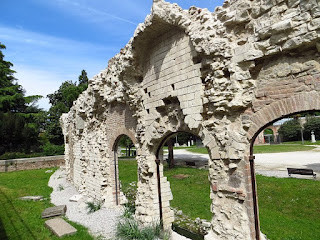
Some remains of the Roman amphiteatre are still visible in the Giardino dell'Arena
Some remains of the Roman amphiteatre are
still visible in the Giardino dell'Arena
Padua is believed to be one of the oldest cities in northern Italy. It was founded in about 1183 BC by the Trojan prince, Antenor.

The Roman writer, Livy, records an attempted invasion of the city by the Spartans in 302 BC. Later attempts at invasions were made unsuccessfully by the Etruscans and Gauls. The city formed an alliance with Rome against their common enemies and it became a Roman municipium in about 49BC. By the end of the first century BC, Padua was the wealthiest city in Italy, apart from Rome.

The Roman name for Padua was Patavium. There isn’t much of Roman Patavium left now, but to get some idea of what it would have looked like, it is worth stopping off to see the remains of the Roman Amphitheatre, or Arena as it was known, which is in Padua’s Giardino dell’Arena, a beautiful public park.

If you leave the railway station, or bus station, and walk towards the city centre along the Corso del Popolo and Corso Garibaldi, you will pass the Giardino dell’Arena on the left-hand side where you will see the remains of one of the original elliptical walls of the Arena. It was probably built during the time of the Emperor Claudius, between about 60 and 70 AD.

The Scrovegni family built a chapel in gardens, decorated by Giotto
The Scrovegni family built a chapel in
gardens, decorated by Giotto
An archaeological project to uncover the remains of the Arena began in 1881 and the area was cleared of weeds and a wall was demolished to provide a better view of what was still standing.

The main entrance would have been near the present-day Piazza Eremitani and on the opposite side would have been the porta libitensis, the door of the dead, through which the bodies of the dead gladiators would have been taken.

Within the elliptical wall, which originally had 80 arches, would have been a circle supported by a barrel vault on which the steps of the auditorium were arranged. Its style and dimensions are believed to have been similar to those of the Roman Arena in Verona.

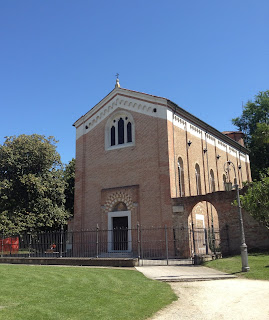
In the 14th century the site was acquired by the Scrovegni family who had a chapel built on it in their name. They commissioned the artist, Giotto, to decorate it with his wonderful frescoes depicting events in the life of the Virgin May and Christ. Today these frescoes are considered to be some of the greatest works of art in the world.

The Arena is open for visitors to look round it every day from 7.00 am, but the site closes earlier in the winter than in the summer.


Home


Friday, November 5, 2021

The colourful life of Padua archaeologist Giovanni Battista Belzoni

The Great Belzoni’s powerful physique helped him remove Egyptian treasures

Giovanni Battista Belzoni during his time as an archaeologist in Egypt
Giovanni Battista Belzoni during his
time as an archaeologist in Egypt
Among the many notable Italians to hail from Padua is the explorer and pioneer archaeologist of Egyptian antiquities, Giovanni Battista Belzoni, who was born in the city on 5 November, 1778, when it was part of the Republic of Venice.

Belzoni became famous for his height and strength and his discovery and removal to England of the seven-ton bust of Ramesses II.

Born into a poor family, at the age of 16 he went to find work in Rome and studied hydraulics. He was planning to take monastic vows but in 1798 French troops occupied the city and he moved to the Batavian Republic, now the Netherlands, where he earned his living as a barber.

He moved to England in 1803, allegedly to escape going to prison. He was six feet seven inches tall and had a powerful physique. For a while he earned his living as a circus strong man under the name The Great Belzoni.

He also exhibited his models of hydraulic engines and went to Cairo in 1815 to offer hydraulic engines for use in irrigation to Muhammad Ali Pasha, the founder of modern Egypt.

But two years later he embarked on another new career, excavating Egyptian tombs and temples for their treasures. It was said he damaged other less valuable objects in the process, which was later frowned upon.

It took 17 days for 130 men to tow the bust of  Ramesses II to a boat bound for England
It took 17 days for 130 men to tow the bust of
 Ramesses II to a boat bound for England
At Thebes he obtained the colossal sculpture of the head of Ramesses II for the British Museum. It took him 17 days and he had to use 130 men to help him tow it the river where it was loaded on to a boat bound for England. In the nearby Valley of the Tombs of Kings, he discovered the tomb of Seti I and removed the aragonite sarcophagus for the Sir John Soane Museum in London. This became known as Belzoni’s Tomb.

While he was in the process of removing an obelisk from the Nile island of Philae, it was taken from him at gunpoint by men working for the French.

He explored an island in the Nile, known as Elephantine, and the temple of Edfu. He also cleared the entrance to the great temple of Ramasses II at Abu Simbel. He was the first to penetrate the pyramid of  Khafre at Giza and he identified the ruins of the city of Berenice on the Red Sea.

Belzoni returned to England in 1819 and published an account of his adventure – Narratives of the Operations and Recent Discoveries Within the Pyramids, Temples, Tombs and Excavations in Egypt and Nubia. It was a two-volume work published in 1820.

The explorer and archaeologist died in 1823 at the age of 45 in Gwato, now called Ughoton, in Nigeria on his way to Timbuktu. In 1825 Belzoni’s widow exhibited his drawings and models of the Royal tombs of Thebes in London and Paris.

There is a road named after Belzoni - the Via Giambattista Belzoni - to the east of Padua's city centre.


Home


Tuesday, May 4, 2021

Padua’s Ghetto

Fascinating area preserves Jewish heritage in the city

A narrow, cobbled street in the Ghetto area of Padua
A narrow, cobbled street in
the Ghetto area of Padua
A small district known as the Ghetto, situated within Padua’s historic centre, still has many shops where craftsmen follow the traditional occupations of Jewish residents in the city.

Jews are recorded as living in Padua as far back as the 13th century. The city was one of the great centres of medieval Judaism, with a celebrated rabbinical academy where students from all over Europe came to study.

Students were also attracted to Padua by its very old medical school, which was the only one to accept Jews.

In 1548 the Venetian authorities decided to require all Jews to reside in an area near Piazza delle Erbe that was called the Ghetto. However, Jewish students were still allowed to graduate from Padua’s prestigious university.

From 1609 all four streets leading to the Ghetto were closed at a certain hour of the evening and guarded gates isolated the district during the night.

The Ghetto was officially abolished in 1797 after Napoleon’s proclamation of the equality of all citizens.

By the 19th century there were three synagogues in the district, reflecting the number of Jewish people then living in Padua.

Piazza delle Erbe, close to the area of Padua where Jewish residents were required to live
Piazza delle Erbe, close to the area of Padua
where Jewish residents were required to live
The number of Jewish residents was greatly reduced in the 20th century and today there is only one synagogue still open for worship, at number 9 Via San Martino e Solferino, where the offices of the Jewish community are also located.  

This synagogue was originally built in 1548 but has been restructured several times. One of the four original gates to the Ghetto, crowned with the lion of Saint Mark, stands nearby.

Full equality for Jewish citizens was achieved in 1866 when Padua was annexed to the Kingdom of Italy.

The former Ghetto has kept much of its original appearance, with the tall narrow houses in Via Arco evoking how the Ghetto must have looked in the past.

The Jewish Heritage Museum at  26 Via delle Piazze, just off Piazza delle Erbe, has precious objects on display that were taken from the two former synagogues no longer in existence, some of them dating back to the 15th century.


Home