Elegant Padova -- known in English as Padua -- is home to an ancient university, a Basilica that is an important centre for pilgrims and a chapel containing one of the world’s greatest art treasures. Use this website to help you plan a visit to this fascinating northern Italian city and find your way to the other beautiful towns and villages in the Veneto that are perhaps less well known to tourists.
Showing posts with label Art. Show all posts

Sunday, October 8, 2023

Church of Santa Sofia in Padua

Romanesque architectural gem had ancient origins

The church of Santa Sofia is the oldest in  Padua, dating back to the early 12th century
The church of Santa Sofia is the oldest in 
Padua, dating back to the early 12th century
The oldest church in Padua is the simple but beautiful Santa Sofia in Via Altinate, a building which is thought to date back to the 11th century.

Santa Sofia is well worth visiting to see an altarpiece painted by Andrea Mantegna when he was just 17, and the font, brought in from another church, in which the two sons of Galileo were baptised.

Built on the site of a Roman temple, Santa Sofia managed to survive 14th century modifications to make it comply with Council of Trent reforms, and the disruption caused by the invasion of Italy by Napoleon’s troops.

The church was carefully restored in the 1950s and today it still retains many of its ancient architectural features and frescoes.

It is believed that the Romanesque stone and brick façade of Santa Sofia was built on ground that was then considered holy between about 1106 and 1127, but the church’s semi-circular apse may have been built earlier. A document has been discovered, dated 1127, that was written to urge completion of the building work in process.

Some of the artefacts found on the site date from between the second and the fourth centuries. And, Santa Sofia’s crypt has been judged, using scientific methods, to have been built within about 50 years of the crypt of St Mark’s Church in Venice. This existed before the 11th century church was built around it to house the remains of St Mark.

The church was carefully restored in the 1950s to preserve the orginal features
The church was carefully restored in the
1950s to preserve the orginal features
Andrea Mantegna’s altarpiece in Santa Sofia, depicting the Madonna and Child in conversation with saints, was painted in about 1450. It was the artist’s first independent work and when he signed it, he gave his age as 17.

Santa Sofia has at times housed Augustinian and Benedictine nuns, but the nuns were expelled from the building during the Napoleonic occupation of the city.

Not to be missed near the entrance to the church of Santa Sofia, is a basin for holy water, which was brought from the Church of Santa Caterina d’Alessandria in Padua. It is believed this basin was used as a font for the baptism of the sons of Galileo.


Home

Tuesday, May 4, 2021

Padua’s Ghetto

Fascinating area preserves Jewish heritage in the city

A narrow, cobbled street in the Ghetto area of Padua
A narrow, cobbled street in
the Ghetto area of Padua
A small district known as the Ghetto, situated within Padua’s historic centre, still has many shops where craftsmen follow the traditional occupations of Jewish residents in the city.

Jews are recorded as living in Padua as far back as the 13th century. The city was one of the great centres of medieval Judaism, with a celebrated rabbinical academy where students from all over Europe came to study.

Students were also attracted to Padua by its very old medical school, which was the only one to accept Jews.

In 1548 the Venetian authorities decided to require all Jews to reside in an area near Piazza delle Erbe that was called the Ghetto. However, Jewish students were still allowed to graduate from Padua’s prestigious university.

From 1609 all four streets leading to the Ghetto were closed at a certain hour of the evening and guarded gates isolated the district during the night.

The Ghetto was officially abolished in 1797 after Napoleon’s proclamation of the equality of all citizens.

By the 19th century there were three synagogues in the district, reflecting the number of Jewish people then living in Padua.

Piazza delle Erbe, close to the area of Padua where Jewish residents were required to live
Piazza delle Erbe, close to the area of Padua
where Jewish residents were required to live
The number of Jewish residents was greatly reduced in the 20th century and today there is only one synagogue still open for worship, at number 9 Via San Martino e Solferino, where the offices of the Jewish community are also located.  

This synagogue was originally built in 1548 but has been restructured several times. One of the four original gates to the Ghetto, crowned with the lion of Saint Mark, stands nearby.

Full equality for Jewish citizens was achieved in 1866 when Padua was annexed to the Kingdom of Italy.

The former Ghetto has kept much of its original appearance, with the tall narrow houses in Via Arco evoking how the Ghetto must have looked in the past.

The Jewish Heritage Museum at  26 Via delle Piazze, just off Piazza delle Erbe, has precious objects on display that were taken from the two former synagogues no longer in existence, some of them dating back to the 15th century.


Home

Thursday, March 11, 2021

Church of the Eremitani frescoes

The day a major work of art was ruined by bombs

Mantegna's Stories of St James was one of the works destroyed
Mantegna's Stories of St James
was one of the works destroyed 
Padua was badly bombed by the Allies on this day in 1944 and the Church of the Eremitani was directly hit, causing devastating damage to the 15th century frescoes painted by Andrea Mantegna in one of the side chapels.

It was one of the worst losses suffered by Italy’s cultural heritage during World War II as Mantegna’s frescoes were considered a major work of art.

Mantegna, who was born in Isola di Cartura near Vicenza in 1431, was commissioned to paint a cycle of frescoes in the Ovetari Chapel, one of the side chapels, depicting scenes from the lives of Saint James and Saint Christopher. The commission marked the beginning of his artistic career when he started work at the age of 17 in 1448. He was in his mid 20s by the time he had finished the cycle in 1457.

Tragically, the German invading army had established their headquarters in Padua next to the Church of the Eremitani, which was why the chapel and the wonderful frescoes were so badly damaged.

They were reduced to more than 88,000 separate pieces and were found mixed in with plaster and bricks on the ground.

A detailed photographic survey of the work had been made previously and it was therefore possible later to reconstruct the artist’s work and recompose part of the cycle depicting the Martyrdom of Saint James. Other frescoes by Mantegna had been removed before the war to protect them from damp and they have also now been reinstated.

In other chapels, 14th century frescoes by Guarentio and Giusto de’ Menabuoi miraculously survived.

The Church of the Eremitani found itself nextdoor to a German army headquarters
The Church of the Eremitani found itself
next door to a German army headquarters
La Chiesa degli Eremitani, or The Church of the Hermits, is a former Augustinian Gothic-style church close to the Cappella Scrovegni in Piazza Eremitani in the centre of Padua.

The church was built for Augustinian friars between 1260 and 1276 and dedicated to the Saints Philip and James.

The friars remained in the church and adjoining monastery until 1806 when Padua was under Napoleonic rule and the order was suppressed. The church was reopened for services in 1808 and became a parish church in 1817.

The church has a single nave with plain walls decorated with ochre and red bricks and has a vaulted wooden ceiling. It houses the ornate tombs of two lords of Padua, Jacopo II da Carrara and Ubertino da Carrara, designed by Andriolo de Santi.

The 15th century side portal is also known as the Door of the Months because of the four panels by the sculptor Nicolo Baroncelli depicting allegories of the months.

The Musei Civici agli Eremitani (Civic Museum) of Padua is now housed in the former Augustinian monastery to the left of the church.

(Picture credit: Church of the Eremitani by Didier Descouens via Wikimedia Commons)


Home


Saturday, February 13, 2021

Jacopo Bassano's Padua masterpiece

The Basilica di Santa Giustina holds one of painter's greatest works

Jacopo Bassano, who died on 14 February 1592, painted altarpieces for many churches in Padua, Treviso, and Belluno.

Bassano's painting of Santa Giustina was executed in about 1560
Bassano's painting of Santa Giustina
was executed in about 1560
Visitors to the Basilica di Santa Giustina, the large church in the southeastern corner of Prato della Valle in Padua, can see Bassano's Santa Giustina enthroned with the saints Sebastian, Antonio Abate and Rocco, which was painted by him in around 1560 with the help of his son, Francesco.

It is considered one of his best works and also one of the most original examples of the Venetian Mannerist culture. 

Bassano was born in about 1510 in Bassano del Grappa, a town about 50km (31 miles) north of Padua, and is said to have been christened Jacopo dal Ponte, although his statue in the town names him as Giacomo da Ponte. His father, Francesco il Vecchio, was already a successful painter in the town and had established a workshop that produced mostly religious works.

Jacopo became an apprentice in his father’s workshop while still a young boy. He made his way to Venice when he was about 20, where he studied under Bonifazio de Pitati, who was also known as Bonifazio Veronese.

While in Venice, he met famous artists, such as Titian and il Pordenone, and his work from this period shows Titian’s influence and demonstrates his lifelong appreciation of the great artist’s work. Jacopo Bassano’s earliest paintings also show his love of the brilliant colours used by Titian.

Bassano’s Supper at Emmaus (1538), originally commissioned for a church, uses rich luminous colours that distinguish the figures from their background. Unusually, he places Christ towards the back of the scene, allowing the figures around him to play a more significant part. He dresses them in 16th century clothes rather than in robes in the classical Roman tradition. He includes food on the table and there are a dog and a cat in the picture, showing he has drawn on contemporary life for his inspiration rather than just sticking to the stylistic conventions of his age.
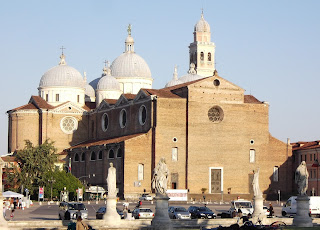
The Basilica di Santa Giustina is a former abbey adjoining the wide Prato della Valle piazza
The Basilica di Santa Giustina is a former abbey
adjoining the wide Prato della Valle piazza
After his father’s death in 1539, Jacopo Bassano returned to Bassano del Grappa and took over the running of the family workshop. He married a local woman, Elisabetta Merzari, in 1546.

His painting of The Last Supper in 1542 shows the influence on his work of Mannerism and indicates that he had seen the paintings of Durer and Raphael because his figures seem alive, with muscles and sinews, in the style of the two great artists.

After about 1550 he started experimenting with light and he was one of the first painters to paint a ‘nocturne’, a scene taking place at night time, which was to make his paintings even more highly valued.  He also tended to place his subjects in a natural landscape with carefully painted trees and flowers.

His four sons, Leandro Bassano, Francesco Bassano the Younger, Giovanni Battista da Ponte and Girolamo da Ponte, all worked in his workshop and followed him closely in style and subject matter.

The Basilica of Santa Giustina, which is the ninth largest Christian church in the world, is at the corner of Prato della Valle where it is joined by Via Avazzano and Via Ferrari. 
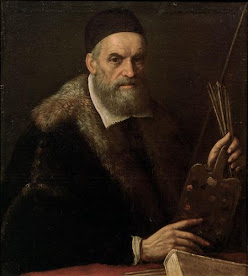
A portrait of Jacopo Bassano by his son, Girolamo da Ponte
A portrait of Jacopo Bassano by his
son, Girolamo da Ponte
The church contains the remains of Santa Giustina, a devout young woman who was martyred in 304, and is also home to the tomb containing the body of St Luke the Evangelist, who was credited with writing the Gospel according to St Luke. Next door to the basilica there is a Benedictine monastery with frescoed cloisters and a famous library that can be visited by arrangement.

After Jacopo’s death in 1592, his sons produced numerous works in his style, making it difficult for art historians to establish which pictures were created by Jacopo Bassano himself and which were the work of his sons.

His work is considered unique because it incorporated diverse artistic influences. He is believed to have learnt from Durer, Parmigianino, Tintoretto and Raphael, even though he lived permanently in Bassano del Grappa, mainly by seeing their prints, of which he became an avid collector.

Bassano del Grappa, where Jacopo Bassano was born and died, and from which he got his professional name, lies at the foot of Monte Grappa in the province of Vicenza and is an easy day trip to make from Padua. The town is famous for inventing grappa, a spirit made from the grape skins and stalks left over from wine production, which is popular with Italians as an after dinner drink to aid digestion. A famous sight in the town is the Ponte degli Alpini, a bridge designed by Andrea Palladio.


Home


Friday, January 22, 2021

Visit Este

The small town that inspired the poet Shelley

The historic town of Este in the province of Padua, with its varied and interesting architecture, is an excellent choice for a day trip from Padua as it takes under an hour by train and about 40 minutes by car.

You can walk into the centre of the town from the station in a few minutes, arriving in Piazza Maggiore, Este’s main square, in time for a drink before lunch.

The remains of the castle surrounded by gardens
Este is a wonderful example of ‘small town Italy’, with reasonably priced restaurants and bars, and plenty of things to see. It is unspoilt and relaxing to be there as it doesn’t get overcrowded with tourists.

To understand its 3000 year history, during which it has been ruled by Romans, Barbarians, important families during the medieval period, the Venetians, the French and the Austrians, you could not do much better than visit Este’s highly regarded Museo Nazionale Atestino. Right in the centre of the town, the museum is housed in Palazzo Mocenigo, a 16th century palace that incorporates part of the walls of the castle into its façade. There are said to be 65,000 items of historical significance in the museum’s collection.

Este’s castle was built in the 11th century by the Este family, who eventually moved on to Ferrara, where they built another, perhaps more famous, castle.

Este’s original castle was destroyed in the 14th century and then rebuilt by Ubertino da Carrara, Lord of Padova. He used it as a defensive outpost against the ruling families of Verona and Milan.

After Este and Padua were taken over by the Venetians, the castle was partially demolished and a wall and towers are all that remain today of the 14th century structure. Inside the walls, there is a beautiful garden, which is open to the public and is a lovely place to sit and rest, particularly when the rose garden is in full bloom.

Piazza Maggiore is in the centre of town
Este’s most important church, the Duomo of Santa Tecla, was erected in the 17th century on the site of an earlier church. It is well worth a visit, if only to see the large painting by Giambattista Tiepolo depicting Santa Tecla praying for the deliverance of Este from the plague.

While in Este you can also see the Villa Kunkler, which was rented by the English poet, Lord Byron, in the early years of the nineteenth century. He allowed his fellow poet and friend, Percy Shelley, to live there with his family between 1817 and 1818. Shelley was so inspired by the natural beauty of his surroundings he wrote some of his best poetry there, including Lines Written Among the Euganean Hills. Inspired by Este he wrote:

‘Of old forests echoing round

And the light and smell divine

Of all flowers that breathe and shine:

We may live so happy there,

That the Spirits of the Air

Envying us, may even entice

To our healing paradise

The polluting multitude:

But their rage would be subdu’d

By that clime divine and calm,

And the winds whose wings rain balm

On the uplifted soul, and leaves

Under which the bright sea heaves;’


Home

Monday, December 14, 2020

Orto Botanico in Padua

Botanical Garden inspired the German writer Goethe
 

The world’s first botanical garden created for educational purposes was opened in Padua in 1545.

Orto Botanico, which has now been listed by UNESCO as a World Heritage Site, was devoted to the growth of medicinal plants that could provide natural remedies for treating illnesses.

Orto Botanico in Padua was designed
 in accordance with Renaiisance ideals

The garden was designed for Padua University by Bergamo architect Andrea Moroni, who based it on a detailed architectonic plan in accordance with Renaissance ideals. It is laid out in the form of a circle enclosing a square, which was divided into four quadrants, in which the plants were grown.

The oldest and most important plants were grown in the hub of the garden, known as the hortus spahaericus.

These include a palm (Chamaerops humilis) planted in 1585, which became known as Goethe’s palm, because the German writer made a careful study of it in 1786 and drew from it his intuitions about evolution. He later published his ideas in an essay about the metamorphosis of plants.

The garden also has greenhouses, which were added at the beginning of the 19th century, and a library, where old scientific documents are preserved.

Padua’s Orto Botanico is still used for research into rare plants and threatened species, with a view to reintroducing them to their natural environment.

The garden is in Via Orto Botanico close to Prato della Valle, one of the city’s main squares, where there is a tram stop. It is open to the public every day, but has closed temporarily due to the Covid 19 pandemic.


Sunday, November 29, 2020

Andrea Palladio

The most admired architect of all time was born in Padua

Palladio became one of the most influential architects in history
Palladio became one of the most
influential architects in history
The world’s most famous and influential architect, Andrea Palladio, was baptised on 30 November in 1508 at the Oratorio di San Michele in Padua.

It is not known whether he was born on the 30th, or on the previous day.

Palladio’s style was to become so popular that architects all over the world designed villas and public buildings copying his interpretation of classical Roman architecture.

For example, the White House in Washington, the home of the President of the United States, built between 1792 and 1800, has many echoes of Palladian style.

Palladio was born Andrea di Pietro della Gondola, either just before, or on the day, of his baptism. He was the son of a miller in Padua.

He found work as a stone cutter in the workshop of a sculptor initially. but moved to Vicenza when he was 16, where he joined a guild of stonemasons and bricklayers. 

It was while working as a stonemason for the poet and scholar Gian Giorgio Trissino that his career began to gather pace. Trissino not only gave him the name Palladio, after the Greek goddess of wisdom, Pallas Athene, but encouraged and helped him to study classical architecture in Rome.

Palladio became fascinated with the work of Marcus Vitruvius Pollio, architect and engineer of the 1st century BC. It was while in Rome that he came across the Pantheon, with its huge hemispheric dome inspired by Vitruvius, which was to influence many of his designs.

The Villa Cornaro in Piombino Dese
The Villa Cornaro in Piombino Dese 
Trissino also introduced Palladio to a number of wealthy and influential families, including the Barbaro brothers, through whom he ultimately became chief architect of the Republic of Venice, having already occupied the equivalent position in Vicenza.

Palladio received his first commissions in the 1530s and thereafter was in constant demand, his style inspiring other architects outside Italy, at first in Europe and later around the world.  One factor in the spread of his fame was his publication in 1570 of his treatise, I Quattro Libri dell'Archittetura (The Four Books of Architecture), which set out rules others could follow.

Examples of Palladio's work can be found all over the region where he lived and in Venice, where he was commissioned to build, among other architectural masterpieces, the Church of San Giorgio Maggiore, the focal point of the view across the lagoon from St Mark's Square through the Piazzetta.

He built a substantial number of villas for wealthy clients across the Veneto region, some of them lining the Brenta Canal that links the lagoon of Venice with Padua. Others such as the Villa Capra, otherwise known as La Rotonda, famous for its symmetrically square design with four six-columned porticoes, can be found in open countryside near Vicenza.

La Rotonda, near Vicenza, is one of  Palladio's most famous buildings
La Rotonda, near Vicenza, is one of 
Palladio's most famous buildings
Vicenza itself features many of Palladio's designs, including the fabulous Teatro Olimpico, in which perspective was used to create the optical illusion of city streets receding from the stage.  He was working on the theatre at the time of his death, after which the project was finished by his son, Silla, one of his five children, and Palladio's assistant, Vincenzo Scamozzi.

Palladio designed two beautiful villas in the province of Padua, Villa Cornaro in Piombino Dese and Villa Pisani in Montagnana.

One of his finest works is considered to be Villa Foscari, otherwise known as La Malcontenta, located next to the Brenta canal at Mira, which is between Padua and Venice.

Palladio died in 1580, aged 71. The cause of his death is not clear but some accounts say he collapsed while inspecting the construction of the Tempietto Barbaro, a church in Maser, near Treviso.

He was initially buried in a family vault in the church of Santa Corona in Vicenza, the city in which he spent most of his life, but was later re-interred at the civic cemetery, where a chapel was built in his honour.


Home

Monday, November 16, 2020

Chiesa di San Nicolò

Romanesque church still has many original features

One of the oldest churches in Padua, the pretty Chiesa di San Nicolò, is tucked away in a square at the end of Via San Nicolò, a turning off Via Dante Alighieri.

An outstanding example of Romanesque architecture, Chiesa di San Nicolò was first mentioned in a document in 1088 when Bishop Milone donated it to the Convent of Saint Peter for the use of the monks.

Chiesa di San Nicolò is about 1000 years old
The church was dedicated to Saint Nicolas of Myra and later acquired some of the saint’s relics.

By the 12th century, San Nicolò was a parish church attended by many of the noble families in the city.

In the 14th century, the church was extended to the side to add the chapel of the aristocratic Forzate family. By 1546 Chiesa di San Nicolò  had 11 altars, many owned by the powerful families who worshipped there, and between 1660 and 1680 some baroque features were added.

The bell tower was rebuilt in the 19th century in Gothic style, but restoration work carried out in the 20th century meticulously preserved many of the church’s original features.

Among the art treasures inside Chiesa di San Nicolò  is an altarpiece by Giovanni Domenico Tiepolo depicting the Sacred Family with Saints Francesca Romana and Eurosia. There are still traces of 14th and 15th century frescoes and there is a 15th century depiction of San Liberale by Jacopo da Montagnana, also known as Jacopo Parisato, an artist from Montagnana who was active in Padua during the 15th century.


Home


Saturday, August 1, 2020

Paolo De Poli


 Painter devoted his life to ancient art of enamelling


One of Italy’s most admired 20th century artists, Paolo De Poli, who became fascinated with the technique of enamelling, was born on this day in 1905 in Padua.

At first De Poli experimented with enamelling small, decorative objects but after he mastered his craft he moved on to creating large panels for the interiors of ships, hotels and public buildings.
Paolo De Poli

De Poli trained in drawing and embossing on metal at the art school Pietro Selvatico of Padua and then studied oil painting in Verona. He embarked on a career as a portrait and landscape painter.

In 1926 he participated in the XVth Biennale di Venezia with the oil painting, Still Life.

While travelling in the 1930s, he visited art museums and archaeological sites and became interested in the traditional art of working with vitreous enamel.From 1933 onwards, he devoted himself to creating enamel works on metal, experimenting with refined objects of many shapes in brilliant colours. He continued to improve his technique, reaching the highest level of skill.

In the 1940s, he collaborated with Milanese architect Gio Ponti in the production of furniture and decorative panels. This led to him producing animal statuettes in sculptural forms and he also produced beautiful vases, bowls, trays, plates, cups, plaques and door handles in enamel on copper.

He also accepted commissions for panels to decorate the homes of collectors in Italy and abroad.

Gio Ponti wrote about him: ‘If we can speak of an Italian art of enamel, it is thanks to De Poli, to the road he opened up and followed faithfully, to the example of his orthodox technique, to his sureness of touch, to the esteem and admiration he has won. And we should be grateful to him for this also.’
The main building of Padua University has works by De Poli

De Poli also dedicated himself to executing altarpieces and cycles of panels on the theme of the Stations of the Cross. These are preserved in churches in Padua, Abano Terme, Treviso and Bergamo.

His creations have been displayed at many international exhibitions and art fairs as expressions of Italian style. Many of his works in enamel on copper are now in the permanent collections of the important museums of decorative art and design.

De Poli was actively involved in the defence of the Italian cultural heritage and the promotion of arts and crafts during his career.

From 1960 to 1973 he served as a member of the board of directors of the Milan Triennale.
In 1970 De Poli was awarded the title of Cavaliere del Lavoro. He died in Padua in 1996, aged 91.

His personal archive of designs, prototypes, photographs and correspondence has been entrusted to the Archivio Progetti of IUAV University of Venice.

Visitors to Padua can see examples of his work in buildings in the city. Two of De Poli’s panels, depicting Podestà Rusca and Vescovo Giordano, are in Palazzo Bò, the main building of Padua University in Via 8 Febbraio. To find Palazzo Bò, leave Piazza Cavour, passing Caffe Pedrocchi on your right and walk down Via 8 Febbraio. The university building is on the left hand side of the street at its corner with Via San Francesco. De Poli’s statuette, Toro (Bull), completed in 1966, is in Padua’s Musei Civici, a complex of museums and historic sites centred round the former convent of the Eremitani in Piazza Eremitani.


Wednesday, February 26, 2020

Porta Altinate Padua


13th century gate is a popular way to enter the city 


One of Padua’s only two remaining medieval gates, Porta Altinate, provides a way into the centre of the city for thousands of people each day.
The 13th century Porta Altinate

Padua’s tram stops on Riviera dei Ponti Romani and when passengers get off they can quickly walk through Porta Altinate to reach the two main squares, Piazza delle Erbe and Piazza della Frutta.

Porta Altinate was one of the gates in the walls built around Padua in the 13th century to protect the city from hostile attacks.

The walls were constructed on the orders of the comune of Padua and there are still a few remnants of them left in parts of the city.

In 1256, Porta Altinate was stormed and destroyed by troops fighting to overthrow the notorious tyrant Ezzelino III da Romano. It was the day the hated ruler finally lost his power over the city. 

The gate was rebuilt in 1286 and the event is recorded in an inscription by the historian, Conte Carlo Leoni, on a memorial stone under the archway.

Porta Altinate’s lookout tower has since been reduced in height and the gate now stands between modern buildings.

Looking at it from Piazza Garibaldi, the gate would once have been reflected in the waters of a canal behind it, but this was filled in to create the section of road called Riviera dei Ponti Romani, which was named in honour of the Roman bridges which now lie below the surface of the road.
Monument to Alvise Pisani

Inside the archway is a monument in baroque style to Alvise Pisani, who was captain of Padua from 1686 to 1687 and then became Doge of the Republic of Venice. The monument was the work of artists studying in Padua at the time.

But the intricately carved stonework is probably missed by many of the pedestrians and cyclists who are in a hurry to pass through the gate each day on their way into Padua.


Monday, September 9, 2019

The Baptistery in Padua


Dazzling fresco cycle has survived nearly 700 years


Standing next to the Duomo in Piazza Duomo, Padua’s Baptistery (Battistero) is a superb example of Romanesque architecture.

The original building was constructed in the 12th century but it was modified in about 1370 to become a memorial chapel for Francesco il Vecchio di Carrara and his wife, Fina Buzzacarini.
The 14th century Baptistery is to the right of the Duomo

The couple invited the artist Giusto de’ Menabuoi to fresco the interior with pictures representing stories from the Bible.

De’ Menabuoi, who was originally from Florence, worked on the interior of the Baptistery between 1376 and 1378. His frescos are remarkable for the brilliance of the colours he used and the details from the Bible he brings to life.

To understand the cycle of pictures you should ideally stand near the old entrance to the Baptistery, which was sealed up when the building was modified. Traces of it can be seen in the structure of arches.

The cycle begins in the cupola with Paradise and finishes in the apse with the Apocalypse. There are 37 episodes from Genesis that lead on in sequence to the 43 scenes from the last book of the New Testament.

In the centre of the apse, on a small marble altar, is a Polyptych, also by De’ Menabuoi, featuring the Madonna and Child, with a picture of the Baptism of Christ above it, while on either side are panels depicting the stories of the Saints.

In the panel showing Christ healing the sick, look out for a figure in a red headdress, which is believed to be a portrait of the poet Petrarch, who died shortly before the frescos were painted.

Venetian soldiers damaged the Cararra family’s grand burial monuments in 1405 and daubed green paint on the emblems of Francesco il Vecchio, but restoration work was carried out on the Baptistery in the 20th century.

Visitors to the Baptistery can see how the Duomo would have looked in the 14th century, before its 16th century makeover, as it appears in De’ Menabuoi’s frescos.

The Baptistery is open from 10 am to 6 pm every day.


Monday, September 18, 2017

Death of artist Andrea Mantegna


The painter Andrea Mantegna, who made a major contribution to Padova’s rich art collection, died on September 13, 1506.

Mantegna was one of a large group of painters entrusted with decorating the Ovetari Chapel in the Church of the Eremitani in Padova.


Part of Mantegna's cycle depicting the Martyrdom
 of San Giacomo. Now partially restored, it
can again be seen in the Ovetari Chapel.
Much of his work was damaged when the Allied forces bombed Padova in 1944, but his paintings of The Assumption and the Martrydom of Saint Christopher survived and others have been painstakingly restored.

Other early work by Mantegna can be seen in the Basilica of Sant’Antonio and in the Church of Santa Giustina in Padova.

Mantegna was born at Isola di Cartura near Padova in about 1431, a village just outside Piazzola sul Brenta, which has now been renamed Isola Mantegna. 

He was apprenticed by the age of 11 to the painter Francesco Squarcione in Padua, who had a fascination for ancient art and encouraged him to study fragments of Roman sculptures.

After eventually parting company with Squarcione, the artist came under the influence of Jacopo Bellini, the father of Giovanni and Gentile Bellini, and in 1453 he married Jacopo’s daughter, Nicolosia.

By 1459 he had moved on to Verona, where he painted a grand altarpiece for the Church of San Zeno.

The following year he was appointed court artist by the Marquis Ludovico III Gonzaga of Mantua. His frescoes for the Bridal Chamber (Camera degli Sposi) at the Palazzo Ducale in Mantua were to influence many artists who followed him because of his innovative use of perspective.

They are considered among his best works and depict the life of Ludovico Gonzaga and his family.The beautiful backgrounds of imaginary cities and ruins reflect Mantegna’s love of classical architecture. 

He introduced spatial illusion with his painting of the ceiling, which although flat appears concave. This technique was followed by other artists for centuries.

Mantegna was also to become famous for his religious paintings, such as St Sebastian, which is now in the Louvre in Paris, and The Agony in the Garden, which is now in the National Gallery in London. 

The artist painted nine pictures of the Triumphs of Caesar, drawing on his classical knowledge, which are also considered by experts to be among his finest works. These were sold in 1628 to King Charles I of England and are now in Hampton Court Palace.

After his death at about the age of 75, Mantegna’s sons set up a monument to him in the Church of Sant’Andrea in Mantua.

The 15th century Basilica of Sant’Andrea is in Piazza Mantegna. The artist’s tomb is in the first chapel on the left, where there is a painting of the Holy Family and John the Baptist by Mantegna.

The church was originally built to accommodate the large number of pilgrims who came to Mantua to see a precious relic, an ampoule containing what were believed to be drops of Christ’s blood mixed with earth. This was claimed to have been collected at the site of his crucifixion by a Roman soldier.

Friday, January 8, 2016

Remembering the genius of Renaissance artist Giotto


The brilliant 14th century painter Giotto di Bondone, who gave Padova its greatest work of art, died on 8 January in 1337 in Florence.

Giotto's depiction of the Last Judgment on the
frescoed walls of the Scrovegni Chapel in Padova

Although much of his work is no longer in existence, the artist who was known simply as Giotto is remembered after nearly 700 years as one of the greatest painters of the early Renaissance period.

It is believed Giotto was born in about 1267 in Florence but it is not known how he learned to paint with such a sense of space, naturalism and drama. His work represented a crucial turning point in the history of art because he painted lifelike, solid figures and put in fascinating background details.

He is believed to be the first artist to make a decisive break with the Byzantine style of painting and draw figures accurately from life.

Giotto’s revolutionary style was followed by many other painters later in the 14th century and it is said that he was actually paid a salary by the commune of Florence because of his excellence.

His most stunning surviving work is undoubtedly the interior of the Scrovegni chapel in Padova. His cycle of frescoes is still considered to be one of the greatest works of art in the world.

Dedicated to Santa Maria della Carita (Saint Mary of the Charity), the chapel was decorated by Giotto between 1303 and 1305. The work was commissioned by Enrico degli Scrovegni, who was hoping to atone for the sins of usury committed by himself and his dead father.

The frescoes narrate events in the lives of the Virgin Mary and Christ and cover the side walls of the chapel. On the wall opposite the altar is Giotto’s magnificent Universal Judgment, which tells the story of human salvation and includes the figure of Enrico degli Scrovegni offering up a model of the chapel to the Virgin Mary in a desperate bid to save his father from hell.

Under a bright blue sky, the realistic figures with their powerful facial expressions and colourful clothes tell the bible stories in a way they had never been told before.
In later life, Giotto was made ‘first court painter’, with a yearly pension by King Robert of Anjou in Naples. He lived in Naples till 1333 but none of his work there has survived.

On his return to Florence he was asked to design the new Campanile for the Cathedral in 1334 and his last known work was the decoration of a chapel in the Bargello.
It is thought Giotto was about 70 years of age when he died on 8 January 1337.

The Scrovegni Chapel in Parco della Arena
Some sources say he was buried in Santa Maria del Fiore, Florence’s Duomo, while others believe he was buried in the earlier church on the site, Santa Reparata.
In the 1970s bones were discovered beneath the paving of Santa Reparata and forensic examination confirmed they were those of a painter.

The bones were reburied with honour near the grave of Brunelleschi in the church, but it is still by no means certain they are actually the remains of Giotto.

It is a miracle Giotto’s frescoes in the Scrovegni Chapel have survived for nearly 700 years. The chapel was acquired by the city of Padova in 1880 and specialised restoration operations have been carried out to preserve them subsequently.

The building, the quality of air and the best way to conserve the frescoes have all been carefully studied.

The chapel can be accessed from Giardini dell’Arena off Piazza Eremitani. There is a separate building where visitors can watch a video to prepare them for seeing the frescoes.

Visits are carefully organised so people can enter the chapel and look at the frescoes without jeopardising their condition.

Tickets should be booked in advance and collected an hour before the visit. For details visit www.cappelladegliscrovegni.it.

Home

Tuesday, August 18, 2015

Agli Eremitani Ristorante Pizzeria


Dine well at traditional restaurant and pizzeria in the heart of Padua

 
Tucked away under the porticos of Via Porciglia, the Agli Eremitani restaurant and pizzeria is handily placed for visitors to the Scrovegni Chapel, home to Giotto’s amazing frescoes, or the Eremitani museum complex.
Agli Eremitani is at Via Porciglia 29
The restaurant serves pizza and speciality dishes from the Veneto using local, seasonal ingredients. They also offer seafood from the nearby Adriatic and international dishes.
Diners have the choice of a secluded alcove in one of the smaller, wood-panelled rooms, a table in the large room with gardens on two sides or an outside table during the summer.
Agli Eremitani serve more than 100 different types of pizza. Their specialty dish is scialatelli ai crostacei (scialatelli with a sauce made from shellfish). The restaurant pride themselves on the range and quality of the wines they keep in their cantina.
Close to the University, Agli Eremitani frequently host lunches and dinners to celebrate le feste di laurea (degree celebrations).
Agli Eremitani is open from 12.00 to 15.00 and from 18.30 to 1.00 am every day except Monday.
For more information or to book a table visit www.eremitani.net.